

Genesis Chapter 8-11
Special thanks are given to Jesus Christ, my Lord and Savior, for the gift of writing and the privilege of sharing this Bible Study. His guidance and blessings have made this work possible, and it is with a grateful heart that this study is presented for 2026. This Bible study is written with inspiration and wisdom from the Holy Spirit, Scripture from the Holy Bible (NIV), analytical support and help in organizing and presentation from Grok AI and writing assistance with drafting and editing from Microsoft Co-Pilot.
Chapter 8: The Flood Recedes and Noah's Sacrifice
The waters subside as God remembers Noah (Gen 8:1). 47 days after resting on Mount Ararat the dove came back with an olive leaf. 54 days the Dove did not return. When Noah was 601 years old the water had dried up from that year. Almost 1 month and 3 weeks later the land was completely dry, and they were able to leave the ark. God told them when it was okay to leave the ark. He gave them the command to multiply on the earth and be fruitful and increase in number.
Then Noah built an altar to the Lord and, taking some of all the clean animals and clean birds, he sacrificed burnt offerings on it. The Lord said in his hear: “Never again will I curse the ground because of humans, even though every inclination of the human heart is evil from childhood. And never again will I destroy all living creatures, as I have done. “As long as the earth endures, seedtime and harvest, cold and heat, summer and winter, day and night will never cease.”
Chapter 9: God's Covenant with Noah and Noah's Drunkenness
God blessed Noah and his sons, saying to them, “Be fruitful and increase in number and fill the earth. The fear and dread of you will fall on all the beasts of the earth, and on all the birds in the sky, on every creature that moves along the ground and on all the fish in the sea; they are given into your hands. Everything that lives and moves about will be food for you Just as I gave you the green plants, I now give you everything. “But you must not eat meat that has its lifeblood still in it.” And for your lifeblood I will surely demand an accounting, I will demand an accounting from every animal. (see my comment)And from each human being, too. I will demand an accounting for the life of another human being. “Whoever sheds human blood, by humans shall their blood be shed; for in the image of God has God made mankind.”
God establishes his covenant with Noah and to his sons with him; “I now establish my covenant with you and with your descendants after you and with every living creature that was with you – the birds, the livestock and all the wild animals, all those that came out of the ark with you – every living creature on earth. I establish my covenant with you: Never again will all life be destroyed by the waters of a flood; never again will there be a flood to destroy the earth.” Then Go gave the sign of the covenant for all generations by placing the rainbow in the clouds. Whenever the rainbow appears God will see it and remember His covenant as will all mankind.
18 The sons of Noah who came out of the ark were Shem, Ham and Japheth. (Ham was the father of Canaan.) 19 These were the three sons of Noah, and from them came the people who were scattered over the whole earth.
20 Noah, a man of the soil, proceeded to plant a vineyard. 21 When he drank some of its wine, he became drunk and lay uncovered inside his tent. 22 Ham, the father of Canaan, saw his father naked and told his two brothers outside. 23 But Shem and Japheth took a garment and laid it across their shoulders; then they walked in backward and covered their father’s naked body. Their faces were turned the other way so that they would not see their father naked. 24 When Noah awoke from his wine and found out what his youngest son had done to him, 25 he said, “Cursed be Canaan! The lowest of slaves will he be to his brothers.” 26 He also said, “Praise be to the Lord, the God of Shem! May Canaan be the slave of Shem. 27 May God extend Japheth’s territory; may Japheth live in the tents of Shem, and may Canaan be the slave of Japheth.” (It was Ham that told of his father but Canaan was the one who got punished. In researching I found that Ham was protected by a blessing from God and that was most likely the reason why the curse fell on his son, but still no definite explanation could be distinguished) 28 After the flood Noah lived 350 years. 29 Noah lived a total of 950 years, and then he died.
Chapter 10: The Table of Nations
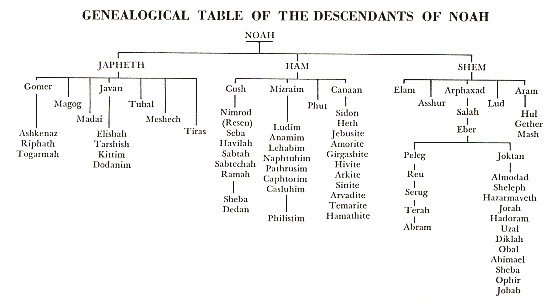
Genesis 10, often called the Table of Nations, lists the descendants of Noah's three sons—Japheth, Ham, and Shem—after the flood. It describes how the nations spread out, forming clans, languages, territories, and peoples.
Chapter 11: The Tower of Babel and Shem's Genealogy
The Tower of Babel
1 Now the whole world had one language and a common speech. 4 Then they said, “Come, let us build ourselves a city, with a tower that reaches to the heavens, so that we may make a name for ourselves; otherwise we will be scattered over the face of the whole earth.” 5 But the Lord came down to see the city and the tower the people were building. (This sets up the theme of hubris (excessive pride). The builders aren't just constructing a monument; they're challenging God's command to "fill the earth" (Genesis 9:1), opting instead for centralized power and self-glorification.) 6 The Lord said, “If as one people speaking the same language they have begun to do this, then nothing they plan to do will be impossible for them. (Language here represents communication and cooperation. Without barriers, humans could pool knowledge and resources indefinitely, but in a post-Flood world still prone to sin (as seen in Noah's descendants), this unity might foster rebellion against God, similar to the pre-Flood wickedness (Genesis 6:5). It's not that God fears human success—He created humans with great capabilities—but He's concerned about how that power might be misused without divine guidance.) 7 Come, let us go down and confuse their language so they will not understand each other.” (This is an act of divine intervention to enforce decentralization. By scattering people through language barriers, God prevents a monolithic society that could spiral into idolatry, tyranny, or further defiance. It's merciful rather than punitive, as it curbs potential for greater evil while fulfilling the mandate to spread across the earth.) 8 So the Lord scattered them from there over all the earth, and they stopped building the city.(This marks the origin of nations and ethnic diversity in biblical lore. The scattering isn't just geographical; it's cultural and linguistic, setting the stage for the rest of Genesis (e.g., the call of Abraham in chapter 12 to form a new nation). 9 That is why it was called Babel—because there the Lord confused the language of the whole world. From there the Lord scattered them over the face of the whole earth. (The story explains real-world diversity (languages, cultures) as part of God's plan, contrasting human attempts at self-unity with God's sovereign design.)God's intervention at Babel isn't arbitrary or jealous; it's rooted in themes of human sin, divine sovereignty, and mercy. Here's a deeper analysis: Humanity's unity in language allowed rapid progress, but the tower symbolized prideful self-sufficiency: "Let us make a name for ourselves" (Genesis 11:4). This echoes the original sin in Eden (Genesis 3), where humans sought to "be like God." If left unchecked, such unity could lead to inventions or societies that defy God's moral order—think advanced wickedness, idolatry, or oppression on a global scale. Unlike the Flood, which wiped out humanity for widespread evil, this is a milder correction. By dividing people, God limits the scale of potential sin—smaller groups are less likely to achieve world-dominating evil. It's like a parent separating squabbling children to prevent escalation. Theologian Matthew Henry notes this as "an act of mercy" to hinder sin's spread. In essence, God acts to preserve humanity from itself, maintaining balance between human potential and divine authority.
Why Does God Use the Phrase "Let Us Go Down"?
The plural "us" in verse 7 ("Come, let us go down") is intriguing and appears elsewhere in Genesis (e.g., 1:26: "Let us make mankind in our image"; 3:22: "The man has now become like one of us"). Here's a detailed explanation:
Christian Interpretation: Reference to the Trinity:
Many Christians see this as an early hint of the Trinity—God as Father, Son (Jesus), and Holy Spirit. The "us" suggests intra-divine dialogue, where God consults within His triune nature before acting. This aligns with New Testament revelations (e.g., John 1:1-3 on the Word being with God). Theologians like Augustine and Calvin viewed it this way, emphasizing God's unity in plurality.
Jewish and Alternative Interpretations:
In Jewish tradition (e.g., Midrash), God speaks to His heavenly court or angels, using a "royal we" for consultation without implying polytheism. This is like a king saying "we decree" to include advisors. Rashi, a medieval Jewish commentator, suggests God consults angels to model humility or justice.
Linguistic Angle: Hebrew sometimes uses plural for emphasis or majesty (pluralis majestatis), similar to the "royal we" in English. Elohim (a name for God) is plural in form but singular in meaning.
Narrative Purpose:
The "us" builds suspense and echoes the "came down" in verse 5, portraying God as deliberate and relational. It contrasts with pagan myths where gods scheme against each other; here, it's harmonious.
Some scholars (e.g., in comparative mythology) note parallels to Mesopotamian epics like Enuma Elish, where gods deliberate in council, but the Bible subverts this to affirm monotheism.
Ultimately, the exact "us" isn't definitively explained in the text, leaving room for interpretation. In Christian theology, it's Trinitarian foreshadowing; in Jewish thought, it's majestic or angelic. Regardless, it highlights God's thoughtful, non-impulsive nature in dealing with humanity.
From Shem to Abram
10 This is the account of Shem’s family line. Two years after the flood, when Shem was 100 years old, he became the father of Arphaxad. 12 When Arphaxad had lived 35 years, he became the father of Shelah 14 When Shelah had lived 30 years, he became the father of Eber. 16 When Eber had lived 34 years, he became the father of Peleg. 18 When Peleg had lived 30 years, he became the father of Reu 20 When Reu had lived 32 years, he became the father of Serug. 22 When Serug had lived 30 years, he became the father of Nahor. 24 When Nahor had lived 29 years, he became the father of Terah. 26 After Terah had lived 70 years, he became the father of Abram, Nahor and Haran.
Terah’s Family
Terah became the father of Abram, Nahor and Haran. And Haran became the father of Lot. 28 While his father Terah was still alive, Haran died in Ur of the Chaldeans, in the land of his birth. 29 Abram and Nahor both married. The name of Abram’s wife was Sarai, and the name of Nahor’s wife was Milkah; she was the daughter of Haran, the father of both Milkah and Iskah. 30 Now Sarai was childless because she was not able to conceive. 31 Terah took his son Abram, his grandson Lot son of Haran, and his daughter-in-law Sarai, the wife of his son Abram, and together they set out from Ur of the Chaldeans to go to Canaan. But when they came to Harran, they settled there.
Study Questions:
What signs does Noah use to determine if the earth is dry?
What is the sign of God's covenant with Noah?
What incident leads to Noah cursing Canaan?
What is the stated purpose of building the Tower of Babel?
How does God thwart the building of the tower?
Who are Terah's three sons, and which one marries the barren Sarai?
Don’t Forget to you can post comments for discussion. If your having trouble posting comments email me at mustardseedchristianbookstore@gmail.com Thank you. See you tomorrow. Have a blessed day.
Written with the assistance of the Holy Spirit, NIV Bible, Grok AI, You Version App., and Co Pilot editor for Microsoft Word.