

Job Chapters 40 - 42
Special thanks are given to Jesus Christ, my Lord and Savior, for the gift of writing and the privilege of sharing this Bible Study. His guidance and blessings have made this work possible, and it is with a grateful heart that this study is presented for 2026. This Bible study is written with inspiration and wisdom from the Holy Spirit, Scripture from the Holy Bible (NIV), analytical support and help in organizing and presentation from Grok AI and writing assistance with drafting and editing from Microsoft Co-Pilot.
Opening Prayer
Heavenly Father, Sovereign Lord of all creation, You who spoke from the whirlwind to a suffering servant named Job— we come before You now with humble and expectant hearts.
We stand in awe of Your majesty: the One who laid the foundations of the earth, who commands the morning and binds the proud waves, who fashioned Behemoth and Leviathan and called them good. Your power is unmatched, Your wisdom unsearchable, and yet You draw near to those who cry out in pain.
As we open these final chapters of Job, quiet our restless questions and proud demands. Help us, like Job, to lay our hands over our mouths, to see You not just with the hearing of the ear, but with the eyes of the heart—truly beholding Your glory and grace.
Forgive us for the times we have spoken of You without truly knowing You. Teach us repentance in dust and ashes, and the courage to trust Your ways even when they remain hidden.
Prepare us to receive Your Word today. May it humble us, heal us, and draw us closer to You— the God who restores, who redeems, and who is faithful forever.
In the name of Jesus Christ, our Redeemer and Advocate, we pray. Amen.
Job 38 - 39 summary
〰️
Job 38 - 39 summary 〰️
Summary
God begins by challenging Job, asking, "Where were you when I laid the earth's foundation?" This chapter emphasizes God's knowledge and power over the creation of the world, the sea, the dawn, and the natural order. God describes how He controls nature, from storms to the constellations, illustrating that human understanding is limited compared to divine wisdom. God continues by asking Job about various animals and their behaviors, showcasing His creation. He mentions the wild goat, the ostrich, and the horse, pointing out their instinctive behaviors and inherent strengths. Through these examples, God illustrates the complexity of creation and the idea that not everything is within human knowledge or control.
Overall, these chapters serve to humble Job and reinforce the theme of trust in God's greater plan, despite human suffering and misunderstanding. We now come to the close of the Book of Job with the Majestic Words of God himself addressing Job and those around him. What an amazing example of God’s strength, power, grace and trustworthiness. Many readers find this both humbling and comforting — a call to worship rather than accusation. I personally found it overwhelmingly a call to worship even greater and stronger than ever. To never question what God asks of me.
Scripture
〰️
Scripture 〰️
Job 40 (NKJV)
God’s Power and Wisdom ¹ Moreover the Lord answered Job, and said: ² “Shall the one who contends with the Almighty correct Him? He who rebukes God, let him answer it.”
Job’s Response to God ³ Then Job answered the Lord and said: ⁴ “Behold, I am vile; What shall I answer You? I lay my hand over my mouth. ⁵ Once I have spoken, but I will not answer; Yes, twice, but I will proceed no further.”
God’s Challenge to Job ⁶ Then the Lord answered Job out of the whirlwind, and said: ⁷ “Now prepare yourself like a man; I will question you, and you shall answer Me: ⁸ Would you indeed annul My judgment? Would you condemn Me that you may be justified? ⁹ Have you an arm like God? Or can you thunder with a voice like His? ¹⁰ Then adorn yourself with majesty and splendor, And array yourself with glory and beauty. ¹¹ Disperse the rage of your wrath; Look on everyone who is proud, and humble him. ¹² Look on everyone who is proud, and bring him low; Tread down the wicked in their place. ¹³ Hide them in the dust together, Bind their faces in hidden darkness. ¹⁴ Then I will also confess to you That your own right hand can save you.
¹⁵ “Look now at the behemoth, which I made along with you; He eats grass like an ox. ¹⁶ See now, his strength is in his hips, And his power is in his stomach muscles. ¹⁷ He moves his tail like a cedar; The sinews of his thighs are tightly knit. ¹⁸ His bones are like beams of bronze, His ribs like bars of iron. ¹⁹ He is the first of the ways of God; Only He who made him can bring near His sword. ²⁰ Surely the mountains yield food for him, And all the beasts of the field play there. ²¹ He lies under the lotus trees, In a covert of reeds and marsh. ²² The lotus trees cover him with their shade; The willows by the brook surround him. ²³ Indeed the river may rage, Yet he is not disturbed; He is confident, though the Jordan gushes into his mouth, ²⁴ Though he takes it in his eyes, Or one pierces his nose with a snare.
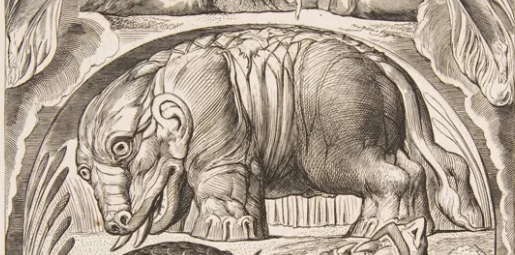
Behemoth image
Job 41 (NKJV)
¹ “Can you draw out Leviathan with a hook, Or snare his tongue with a line which you lower? ² Can you put a reed through his nose, Or pierce his jaw with a hook? ³ Will he make many supplications to you? Will he speak softly to you? ⁴ Will he make a covenant with you? Will you take him as a servant forever? ⁵ Will you play with him as with a bird, Or will you leash him for your maidens? ⁶ Will your companions make a banquet of him? Will they apportion him among the merchants? ⁷ Can you fill his skin with harpoons, Or his head with fishing spears? ⁸ Lay your hand on him; Remember the battle—Never do it again! ⁹ Indeed, any hope of overcoming him is false; Shall one not be overwhelmed at the sight of him? ¹⁰ No one is so fierce that he would dare stir him up. Who then is able to stand against Me? ¹¹ Who has preceded Me, that I should pay him? Everything under heaven is Mine.
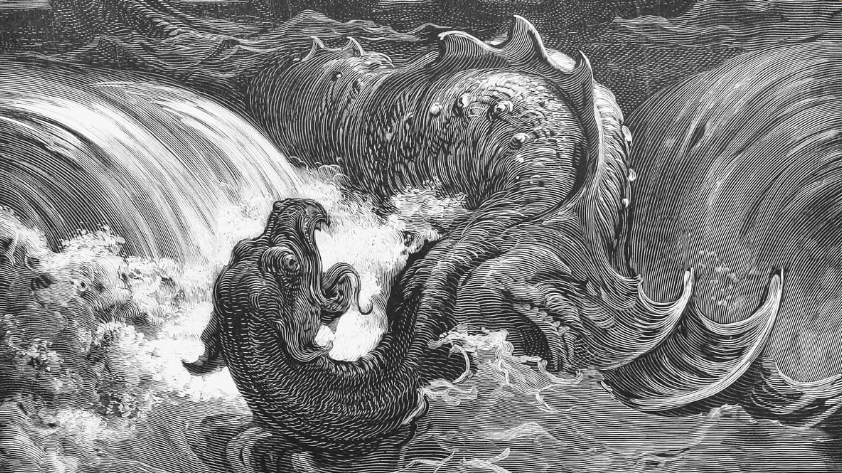
¹² “I will not conceal his limbs, His mighty power, or his graceful proportions. ¹³ Who can remove his outer coat? Who can approach him with a double bridle? ¹⁴ Who can open the doors of his face, With his terrible teeth all around? ¹⁵ His rows of scales are his pride, Shut up tightly as with a seal; ¹⁶ One is so near another That no air can come between them; ¹⁷ They are joined one to another, They stick together and cannot be parted. ¹⁸ His sneezing’s flash forth light, And his eyes are like the eyelids of the morning. ¹⁹ Out of his mouth go burning lights; Sparks of fire shoot out. ²⁰ Smoke goes out of his nostrils, As from a boiling pot and burning rushes. ²¹ His breath kindles coals, And a flame goes out of his mouth. ²² Strength dwells in his neck, And sorrow dances before him. ²³ The folds of his flesh are joined together; They are firm on him and cannot be moved. ²⁴ His heart is as hard as stone, Even as hard as the lower millstone. ²⁵ When he raises himself up, the mighty are afraid; Because of his crashings they are beside themselves. ²⁶ Though the sword reaches him, it cannot avail; Nor does spear, dart, or javelin. ²⁷ He regards iron as straw, And bronze as rotten wood. ²⁸ The arrow cannot make him flee; Slingstones become like stubble to him. ²⁹ Darts are regarded as straw; He laughs at the threat of javelins. ³⁰ His undersides are like sharp potsherds; He spreads pointed marks in the mire. ³¹ He makes the deep boil like a pot; He makes the sea like a pot of ointment. ³² He leaves a shining wake behind him; One would think the deep had white hair. ³³ On earth there is nothing like him, Which is made without fear. ³⁴ He beholds every high thing; He is king over all the children of pride.”
Job 42 (NKJV)
Job’s Repentance and Restoration ¹ Then Job answered the Lord and said: ² “I know that You can do everything, And that no purpose of Yours can be withheld from You. ³ You asked, ‘Who is this who hides counsel without knowledge?’ Therefore I have uttered what I did not understand, Things too wonderful for me, which I did not know. ⁴ Listen, please, and let me speak; You said, ‘I will question you, and you shall answer Me.’
⁵ “I have heard of You by the hearing of the ear, But now my eye sees You. ⁶ Therefore I abhor myself, And repent in dust and ashes.”
⁷ And so it was, after the Lord had spoken these words to Job, that the Lord said to Eliphaz the Temanite, “My wrath is aroused against you and your two friends, for you have not spoken of Me what is right, as My servant Job has. ⁸ Now therefore, take for yourselves seven bulls and seven rams, go to My servant Job, and offer up for yourselves a burnt offering; and My servant Job shall pray for you. For I will accept him, lest I deal with you according to your folly; because you have not spoken of Me what is right, as My servant Job has.” ⁹ So Eliphaz the Temanite and Bildad the Shuhite and Zophar the Naamathite went and did as the Lord commanded them; for the Lord had accepted Job.
¹⁰ And the Lord restored Job’s losses when he prayed for his friends. Indeed the Lord gave Job twice as much as he had before. ¹¹ Then all his brothers, all his sisters, and all those who had been his acquaintances before, came to him and ate food with him in his house; and they consoled him and comforted him for all the adversity that the Lord had brought upon him. Each one gave him a piece of silver and each a ring of gold.
¹² Now the Lord blessed the latter days of Job more than his beginning; for he had fourteen thousand sheep, six thousand camels, one thousand yoke of oxen, and one thousand female donkeys. ¹³ He also had seven sons and three daughters. ¹⁴ And he called the name of the first Jemimah, the name of the second Keziah, and the name of the third Keren-Happuch. ¹⁵ In all the land were found no women so beautiful as the daughters of Job; and their father gave them an inheritance among their brothers.
¹⁶ After this Job lived one hundred and forty years, and saw his children and grandchildren for four generations. ¹⁷ So Job died, old and full of days.
Meet Behemoth & Leviathan
〰️
Meet Behemoth & Leviathan 〰️
Behemoth and Leviathan are two of the most fascinating and mysterious creatures described in the Bible, appearing prominently in Job chapters 40–41 (NKJV). God uses them in His final speeches to Job to demonstrate His unmatched power, sovereignty over creation, and authority over forces far beyond human control. These descriptions humble Job and emphasize that only God can tame or master such mighty beings.
Behemoth (Job 40:15–24)
God introduces Behemoth as a massive land creature He made alongside humanity ("which I made along with you"). Here are key features from the text:
It eats grass like an ox (herbivorous).
Immense strength in its hips and stomach muscles.
Tail moves "like a cedar" (suggesting great size and rigidity).
Bones like bronze beams and ribs like iron bars.
It is the "first of the ways of God" (chief or premier among God's works).
It dwells peacefully among rivers, lotus trees, and marshes, undisturbed even if the Jordan River rages.
Leviathan (Job 41)
Leviathan is portrayed as an even more terrifying sea creature — untamable, invincible to humans, and utterly fearsome. God asks Job a series of rhetorical questions to show no human can capture or subdue it:
Cannot be hooked, snared, or leashed like ordinary animals.
Armor-like scales so tight no air passes between them.
Eyes like dawn, mouth spewing sparks and fire, breath kindling coals.
Iron and bronze weapons are useless against it — regarded as straw.
It makes the deep boil and leaves a shining wake.
"On earth there is nothing like him... He is king over all the children of pride."
These vivid images evoke a fire-breathing, armored sea monster of unimaginable power.
Interpretations of Their Identity and Meaning
Scholars and theologians offer several views on what Behemoth and Leviathan represent:
Mythological Chaos Monsters In the Bible, God defeats such forces to establish order (Psalm 74:14; Isaiah 27:1). In Job, they illustrate God's supreme control over chaos, evil, suffering, and pride — forces Job cannot challenge.
Symbolic of Evil or Satan They represent untamable evil, chaos, or the Accuser (Satan from Job 1–2), whom only God can ultimately subdue.
The core message in Job remains the same regardless of interpretation: These creatures — whether literal, symbolic, or both — highlight humanity's limits and God's infinite power. Job cannot control them, just as he cannot question or judge God's ways. This leads to Job's humble repentance: "I have heard of You by the hearing of the ear, but now my eye sees You" (Job 42:5).
In Summary
God begins by gently but firmly challenging Job's right to question His justice (Job 40:1–14). He asks essentially:
“Would you condemn Me so that you may be justified? Do you have an arm like God’s, or can you thunder with a voice like His?” (Job 40:8–9, paraphrased)
God then points Job to two awe-inspiring creatures — Behemoth (Job 40:15–24) and Leviathan (Job 41) — symbols of immense, untamable power and chaos in creation. No human can subdue or control them, yet God made them, rules them effortlessly, and governs everything under heaven (Job 41:11: “Who has a claim against Me that I must pay? Everything under heaven belongs to Me.”).
These descriptions emphasize that:
The world is full of majestic beauty and wild, dangerous forces.
Humans lack the knowledge, power, or perspective to run the universe or judge God's ways.
God sovereignly reigns over all things — including chaos, evil, and suffering — without ever losing control.
God doesn't provide a neat "reason" for Job's pain (the book never explains the heavenly wager from chapter 1). Instead, He invites trust in His superior wisdom.
Job's Humble Response (Job 42:1–6)
Confronted with God's majesty, Job is overwhelmed and repents in dust and ashes:
“I know that you can do all things; no purpose of yours can be thwarted... Therefore I despise myself and repent in dust and ashes.” (Job 42:2, 6)
This is a shift from demanding answers to humble awe. Job moves from hearing about God to truly seeing Him — a deeper, personal encounter that brings peace even without full understanding.
The Restoration and Final Message (Job 42:7–17)
God rebukes Job's friends for misrepresenting Him, affirms that Job spoke rightly about God, and instructs Job to pray for them. After Job intercedes, God restores Job's fortunes twofold — new children, greater wealth, and a long, blessed life.
Core Messages from God to Us in These Chapters
These chapters deliver several timeless truths for anyone facing suffering, doubt, or unanswered questions:
God is infinitely greater than we can comprehend. We are finite creatures; He is the Creator who sustains the entire cosmos. Questioning His justice assumes we know better how the universe should work — but we don't.
Faithful trust matters more than complete understanding. God asks for humble reliance on His character and wisdom, not a full explanation of every trial. Suffering isn't always punishment for sin, and the reasons for it often remain mysterious to us.
God is sovereign over everything — including chaos and evil. Nothing is outside His control. He doesn't need our permission or advice to govern the world.
God welcomes honest cries and questions. He doesn't silence Job's pain but meets him in it, leading to deeper intimacy and repentance.
God is ultimately gracious and just. While the book doesn't promise easy restoration for everyone in this life, it shows that God sees, vindicates the faithful, and works for their ultimate good — even if the "how" and "when" remain hidden for now.
In essence, God's message in Job 40–42 is this: “Trust Me. I am God, and you are not. My ways are higher, My power is unmatched, and My wisdom is perfect — even when life feels unfair. Bring your pain to Me, humble yourself before Me, and find rest in who I am.”
This doesn't erase suffering, but it reframes it in light of God's overwhelming greatness and trustworthiness. Many readers find this both humbling and comforting — a call to worship rather than accusation.
Bible Study Questions
In Job 40:1–5 and 42:1–6, Job moves from defending himself to covering his mouth in silence and then repenting in dust and ashes. What specific aspects of God's speech (His questions about creation, Behemoth, and Leviathan) seem to finally break through Job's arguments and lead him to this humble surrender?
God asks Job in 40:8–14, “Would you indeed annul My judgment? Would you condemn Me that you may be justified?” How does this challenge the way people (including Job and us) sometimes view suffering or question God's fairness?
Describe the characteristics of Behemoth (40:15–24) and Leviathan (41:1–34). Why do you think God chooses these untamable creatures to illustrate His power rather than something more familiar or comforting?
In Job 41:10–11, God declares, “Who then is able to stand against Me? … Everything under heaven is Mine.” How does this connect back to the earlier accusations from Job’s friends and Job’s own cries for justice?
After Job’s repentance (42:1–6), God turns to the friends and says they have not spoken rightly of Him as Job has (42:7–8). What does this reveal about the difference between speaking “about” God and truly knowing Him?
In the restoration (42:10–17), Job receives double what he lost, new children, and long life. Why do you think the text emphasizes Job praying for his friends first, before his own blessings are restored? What does this teach about forgiveness and intercession?
How can the journey of Job—from questioning God, to awe-filled silence, to repentance, and ultimately to restored relationship—shape the way you respond to unanswered prayers, deep suffering, or times when God feels silent in your own life right now? What one practical step could you take this week to move toward humble trust in God's sovereignty, even when you don't understand His ways?
See you Tomorrow in Genesis